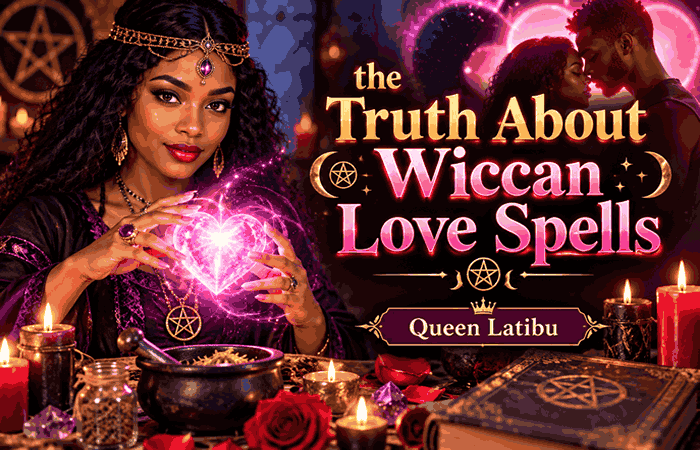
Wiccan love spells have become hugely popular, thanks in part to social media, books and films. With that popularity has come a great deal of confusion. Some people believe Wiccan spells are harmless fun with no real power. Others fear they are dangerous or manipulative. The truth lies somewhere else entirely.
In this article, Queen Latibu answers the questions people ask most often about Wiccan love spells, drawing on years of experience in traditional spiritual work.
Do Wiccan love spells really work?
Many people report positive changes after performing Wiccan love spells, especially rituals focused on self-love, healing and attracting a new partner. These spells work by focusing intention, raising energy and aligning a person with the kind of love they are seeking.
Like all spiritual work, results vary. A spell performed with sincerity, the right timing and realistic expectations is far more likely to bring change than one performed in haste or desperation. Spells are not vending machines; they work with the energy of the people involved.
Are Wiccan spells safe?
Wiccan spells that follow the principle of "harm none" are generally gentle and safe. They avoid forcing anyone's will and focus on positive outcomes. The main practical safety issues are physical: never leave candles unattended, use herbs and oils carefully, and never consume anything that is not food-safe.
Emotional safety matters too. If you find yourself repeating spells obsessively or relying on them to cope with distress, it may be time to speak to a counsellor or a trusted friend as well.
Can a Wiccan spell make a specific person love me?
This is the most common question, and the answer reveals a key part of Wiccan ethics. Many Wiccans avoid spells that target a specific person without their consent, because doing so interferes with free will. Instead, they cast spells to attract the right partner, or to strengthen an existing relationship where love is already mutual.
African traditional healers like Queen Latibu do sometimes work on a relationship with a specific person, but only after a reading confirms that genuine feelings exist and that the work will not cause harm. The goal is to remove obstacles, not to override anyone's will.
Is Wicca the same as witchcraft?
Not exactly. Wicca is a specific spiritual path with its own beliefs, rituals and ethics. Witchcraft is a broader term for the practice of magic, which can exist within many traditions, including folk practices that are not religious at all. All Wiccans may practise witchcraft, but not all people who practise witchcraft are Wiccan. Read more in is witchcraft real? Common myths exposed.
Do I need special tools?
No. Crystals, candles, herbs and altars can help focus intention, but they are not essential. Some of the most powerful Wiccan love work involves nothing more than a quiet space, a clear mind and heartfelt words. If you do use tools, choose items that feel meaningful to you.
How long does a Wiccan love spell take?
There is no fixed timeline. Attraction spells may take one or more lunar cycles to show results, while self-love rituals often bring a sense of calm and confidence almost immediately. Patience is part of the practice. Wiccans often say that magic works through natural channels, such as a chance meeting or an unexpected invitation, rather than through sudden miracles.
Can a Wiccan spell backfire?
Spells cast with anger, jealousy or a desire to control can bring unwanted results, which is one reason Wiccan ethics stress harm none. A spell that is too vague may also bring unexpected outcomes. For example, asking simply for "someone to love me" without thinking about qualities like kindness and honesty may attract attention you do not want. Clear, positive, well-considered intentions reduce these risks.
Should I cast a spell myself or ask a practitioner?
For self-love, healing and general attraction, many people enjoy casting simple spells themselves. For complex situations, such as a painful break-up, outside interference or a relationship you cannot read clearly, an experienced practitioner can offer insight and skill that is hard to achieve alone.
A professional reading can also reveal whether a spell is needed at all, or whether something else, such as healing or protection, would serve you better.
How is Queen Latibu's work different?
Queen Latibu practises African traditional healing rather than Wicca. The two share a respect for nature, ethical intentions and attention to timing. African tradition adds deep ancestral knowledge, inherited rituals and the guidance of ancestral spirits. Clients who are drawn to Wiccan values often find this approach familiar and comforting, with an added depth that comes from generations of practice.
Are there love spells I should avoid?
Avoid any spell, Wiccan or otherwise, that aims to punish someone, force them to leave a partner, make them ill or bind them against their will. These spells move into the territory of black magic and can bring heavy consequences for everyone involved.
What is the best first step?
Start with yourself. A self-love ritual helps you clarify what you want and raises your energy, making any later love spell more effective. Then, if you need more help, seek a reading from an experienced practitioner who can look at your situation in depth.
Still curious?
If you have questions about Wiccan love magic or would like to explore traditional African love spells, contact Queen Latibu for a private consultation. You may also enjoy Wiccan love spells and the hidden secrets of love spells.
Ready to talk about your situation?
Queen Latibu offers private consultations by WhatsApp, phone and email.
Spiritual services are provided according to traditional belief and for personal guidance. Results vary and are not guaranteed. See our disclaimer.